


Day 1- Friday:
Tanjung Puting is a national park in Indonesia located in the southeast part of West Kotawaringin Regency in the Indonesian province of Central Kalimantan (Central Borneo). The nearest main town is the capital of the Regency, Pangkalan Buun. Kalimantan is very different than the other islands we have visited in Indonesia. It’s very humid. Initially it reminded me of Kauai fifty years ago, rural, simple and tropical. The airport is very small with one luggage belt.
This adventure really addresses many of Missy’s fears and professed dislikes. Heat, humidity, mosquitos, sleeping on a boat, sleeping under a mosquito net, snakes, spiders, etc. I’m writing this as a journal of our Orangutan trip.
Our guide Darmin has been great. He shows up to explain things but then he gives us space. You see, we have the entire top levels of the boat, the sleeping eating area and the rooftop deck. Apparently only a handful of the 86 boats conducting this kind of tour have the roof deck. So far except for eating and sleeping that’s where we hang out. Nothing to obstruct our view and we have two comfortable chairs.


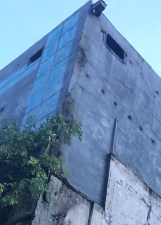
We left the dock at about 4:00pm on Friday. We were immediately confronted with too much awesome food for a late lunch. We passed these large concrete structures that I thought were warehouses. WRONG. You really won’t believe this. Have you heard of bird nest soup? Well, this is one of the places the bird nests come from. The warehouse structure has all these holes on the sides. Sparrows build nests in them. Yep, these nests are harvested at some scheduled frequency and sold.
We have the boat all to ourselves and are accompanied by the Captain, Ide, assistant. Japir, cook, Tirma and our English speaking guide, Darmin.


We headed down a wide river to a smaller river called Sekonyer that would take us to the Tanjung Puting National Park. We turned left and headed to the park. We passed several villages, one Homestay and one hotel. At one point we stopped to watch a troop of proboscis (long-nosed) monkeys. It was getting dark so the captain tied us up along the shore and we were served another fantastic meal. The evening was cool. I sat on the deck looking at the lightening. Later I slipped under the netting onto our mattress, on the floor of the boat, falling fast asleep.


We had been told that there really wouldn’t be a problem with mosquitoes on the river. How could this be. Jungle, water, heat to me that means mosquitoes. They just were not an issue for me. Missy is a mosquito magnet and they hardly bothered her. We did use mosquito replants off the boat and in the jungle, when our guide told us to.
Sleeping under the mosquito net was awesome. I want one for the room we use in El Salvador. Once set up, there really isn’t a way for the little pests to get in. So no buzzing around your ears at night.
We slept on two single mattresses put together on deck. Having no walls the breeze was super refreshing. Warm but not hot and a little humid but not sweaty humid. We both slept soundly in the quiet night. Very comfortable.
At about 5:30 the sky started to lighten. A faint rain started. Later the rain was heavier. Everyone is getting up. Omelette with potatoes, coffee, juice and toast with Nutella.
Started out at 7:30. The flora has changed. Taller trees. Different palm.


Darmin gave us a few facts. There are 64,000 orangutan in Kalimantan. 6,000 at the park. 5,000 in the wild and 1,000 in rehab. The orangutan species that lives in Tanjung Puting National Park is Pongo pymaeus.
Having the rooftop deck is awesome. You can sit up there with no obstruction to your view.
In the boat ahead of us there is a family with five young children playing on deck.
We see troops of monkeys in the high treetops and a Storm’s stork (a big bird with a long beak.)
Day 2 – Saturday, Meeting The Orangutan:
Really too amazing to make too many comments. But here goes.
Feeding Stations:
I assumed that these were set up so tourists could observe the orangutan. Yes, that is the result but the purpose is something much more noble. Of the 6000 orangutan in the Park a 1000 are rescued. They are rescued or turned in by villagers. If I understand it correctly some years ago it became illegal to keep them. In addition with the forest’s conversion to agriculture and the poaching, many adults orangutans were killed, leaving a lot of orphans. The orangutan organization is rehabilitating them. The feeding stations provide a steady source of food until they are able to make it on their own.
Adult orangutan are solitary animals. They live about 58 years old. Females can have babies at 15 to 35. They normally have children every 5-8 years. The baby is breast fed until 5/6 and stays with the mother until about 11/12. There is one dominant – alpha – male in each area.
Apparently in this park there are three feeding stations. Today, Saturday we started at #2 then went to #3 and will visit #1 on Sunday.
On the way up river we see our first troop of monkeys. Later we saw our first orangutan, Mario. He is a rescued animal that lives mainly away from the feeding station. It seems he likes to interact with humans. We stayed with him for sometime before continuing on and saw him again on our way back. He would get very close almost able to jump on to the boat.


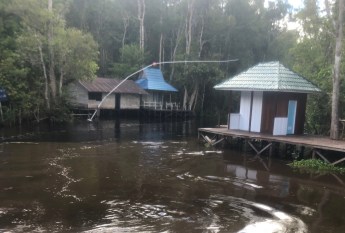
It was really interesting to note the change of the color of the water, from light brown to black as we took the right fork in the river. The black color is caused by the peat.
Feeding Station #2:
Our kelotok (the wooden boat) needed to tie up along side of two others that we used as a path to the dock. From the dock we walked some 700 meters on a raised wooden path to the ranger station where Darmin paid the entrance fees. We walked about 1.2 meters more to the feeding station. The feeding station is a simple wooden platform about 2 meters off the ground. Maybe 3m X 7m. The rangers place various fruits on the platform. Today it was banana but it could be any fruit or vegetable in season.


There are simple benches for the tourists to use and a rope to mark how close we can get. We waited. The rangers make a sound to call out to the orangutan to remind them that it’s meal time. We waited. I was wondering if they would ever come. We waited. Then we heard a rustling in the bushes and eventually several mothers with children came and ate. Here a picture truly is worth a 1000 words so check out the few photos here and look at the rest of our picture (close to 400) to get the taste of our trip and the fascinating and fabulous Orangutans:
https://photos.app.goo.gl/j6J3IPX0xGdfHaFt1


After two hours, we left station #2, got back on the boat and headed further upstream eating another scrumptious meal.
Feeding Station #3- Camp Leaky
This is a research and feeding station. It started in 1971 and it is named after Louis Leaky, the African anthropologist. Jane Goodall has some association with her.
We tied up along side other boats and again used them as a path.
(Its 5:45 am Sunday as I continue to write this. The crew is waking up. They are getting water to fill the tank used to flush the toilet. And I hear the cook).
Again from the dock a raised wooden path across the swamp. This time it ends at Camp Leaky. Camp Leaky has full time staff, visiting researchers, and tourists that come at feeding time. There is a wonderful information center that clearly describes the plight of these magnificent animals. From here we walk along a path to the station. I’m curious so I ask Darmin: “If these are solitary animals how do they meet to mate.” He explains. Darmin’s English is good but there are gaps in what I learned that I will need to google about.
Feeding station #3 is about the same size as #2. There are more benches and the rope keeps us further away, at about 7meters. The rangers sweep off the debris from the platform then add more fruit. Again apparently banana. They call out. We wait.
Soon a mother with young baby arrives and passes right in front of Missy. In a short time maybe a dozen mother/child and singles come and go. Then the area’s dominate male,Terry, comes. He looks pretty huge to me. The others head to the trees giving him plenty of space. He eats and wonders off. Slowly, and cautiously, those in the trees and others individually, return to eat.


Several youth are playing together in the trees right above the platform. Terry returns and sits on the platform. The two youth tentatively make their way to the platform. Terry reaches out and grabs one. She attempts to get away. They start mating. Mating on the platform and on the ground. She is 12. He is 29. According to our guide, Darmin, this is only seen every 3-6 months. I don’t need to google about the mating process now.
We head back to the boat. We tie up at the dock at a Government forest research station. Here Indonesian and international researchers come to study the flora and fauna of the region.
The plan is to do a night trek at the station and sleep there. We appreciate the privacy given to us by our crew. The other boats are much noisier.
Frankly I wasn’t paying attention and didn’t know what the night trek was about. Missy wasn’t going but I was game. After sunset we headed off. We met our local guide. The trek is a loop. We went one direction and the couple from the second boat the other. We met them along the path. We saw beautiful birds sleeping under the tree leaves. Spiders, including several tarantula, a forest ant, and a tarsier monkey with its big eyes. Awesome!!!!


Our dock mates were heard talking, peeing, and snoring through the night. An experience I could have done without. Darmin thought they were very quiet, expectations I guess. As Missy says, the silence in the jungle is a spiritual experience. You hear the birds, insects, monkeys, etc. and marvel at the beauty of the nature.
Day 3-Sunday:
Up at 5:30am as the sky is starting to lighten. I have my coffee, Indonesian style( fine grind, three small heaping spoonfuls, hot water, stir.) i wait for the grounds to settle. Sit on my chair watching the day start. I’m the only one awake. Write the blog. Have a second cup of coffee. The boat starts waking up. Another great meal. The other boats are awake and talking nonstop, lol. For us it’s spiritual, for them, I guess, it’s another day.
After breakfast we went back to the research station. The activity for today was to plant a tree. We walked the short distance from the dock to the station. We met a couple of the staff, chose a tree and planted it. The tree name along with our name, date, and country on a card stapled onto a stick. We hung out at the station awhile then headed back to the boat. We headed out for a very leisurely cruise down the river to Station 1. Missy had the extra treat of getting a massage from the cook who in addition of cooking great meal can give great massages.
Feeding station #1:
We arrived at Station 1 quite early so we had plenty of time. We met an interesting woman on a 9 day boat trip. She was on Day 3 and had done it all. There is a very informative center where we read a lot about orangutans. At 2:30 we headed off. Feeding station short walk away. Orangutans were there waiting. Young adult males, mothers with babies, older children. We had a fascinating 90 minutes observing them. This was our last station. I wanted to cherish every moment. As we were leaving several orangutans passed over us in the trees. Missy did a bit of video taping of this event.
No words can describe the excitement of watching the animals in their natural habitat.The National Park is great but will it be enough for the survival of this species. Seeing the poverty in the country one understands the interest in developing the forest. But is there a better way. I think so but it’s unlikely that things will change. We are so glad to have seen the jungle and the orangutan. Will it be there for our great grandchildren? I don’t know.
We left the station with a feeling of sadness. What a great experience!!!!!! We cruised into the sunset heading back to port but not before one more great meal and adventure. The shore of this part of the river is lined with palm used to make roofs. It grows right into the river. After a glorious sunset the sky was pitch black. Amongst the palms we saw millions of fireflies as we drifted and cruised watching them for an hour. It was magical!!!!
A couple of hours after sunset and another awesome meal, we made our way into the main river with boats and barges. Cellular service was regained. We got to the dock, said our goodbyes, climbed into the taxi and off we went to our hotel in Pangkalan Buun.
PB is a very small village with a tiny airport. The only attraction in town is a beautiful and brightly colored boardwalk. People seemed extremely friendly and we got to meet and take pictures with this sweet girl and her friend.


Note for those interested in doing the tour:
We did A LOT of research before choosing the tour company and was very Happy with the one we selected. The owner, Dessy was extremely responsive and the tour was everything they claim on their website:
http://www.orangutanapplause.com/
Other useful links:
https://orangutan.org/rainforest/tanjung-puting-national-park/
 “The earth is but one country”